
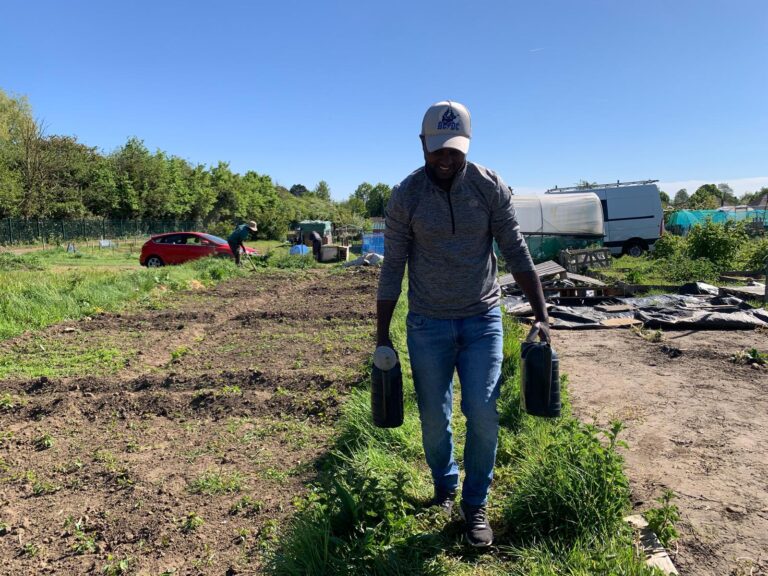
Four years have now passed since this adventure began. On one side there was Grow Cook Eat, on the other the United African Association. What connected the two was a shared desire, a common vision, and the determination to turn an idea into something living and real.
I cannot remember exactly how the connection first came about, but somehow, at some point, the bridge was built. Kathleen explained the purpose of the project and asked whether we would like to take part. The vision was simple and yet profound: to prevent illness, to support our NHS by helping people avoid needing it in the first place; to encourage healthier diets; to restore a closeness with the land, the soil, the fresh air; to help people step out of isolation, leave the house, socialise, reconnect with nature, and in doing so improve both physical and mental wellbeing.
At UAA, we were immediately in favour of it. The United African Association began in 2014, first as an association and later as a charity. From the beginning, its purpose was to support African and Black communities across Northampton and Northamptonshire with a wide range of needs: financial advice, immigration signposting and follow-up support, housing issues, food poverty, domestic abuse signposting and moral support, physical activities and sports to improve wellbeing, and above all, to foster a sense of belonging and inclusion.
So, the idea of a community allotment was warmly embraced, and everything truly began with the Champions Training. Before that, my own experience with growing things was rather limited. Yes, I had planted a few flowers and tomatoes in my garden, but mostly with the assistance of my wife, and that was about the extent of my knowledge.
And so, there I was, attending this training alongside another member of the community. We learned how to grow produce, what constitutes a healthy diet, what to plant and when to plant it. There were cooking sessions too, centred around using produce from the allotment itself. But perhaps most importantly, we were taught how to bring this programme into our own community — how to organise it, sustain it, and make the sessions meaningful and engaging for others.
That was what made the training so valuable. It was not only about knowledge, about the “what”; it was also about the “how.” How to create participation. How to build consistency. How to make something flourish within a community setting. That was the true beginning of everything.
From there, we continued the project year after year. We divided it into allotment sessions and cooking sessions. At the allotment, David — the other participant who had done the training — became the commander of the “troops.” Every week we would gather there, and David would guide us patiently through the process, helping us understand what we were doing and why.
I cannot now remember exactly what vegetables we planted during that first year. It was very much a learning curve. Over time, different people came to help at the allotment, and various leaders shared their knowledge and experience with us. Yet beyond the practical learning, something else was happening there. The allotment fostered a sense of community and lightness — something about being outdoors.
For me personally, one of the most fascinating aspects was discovering African methods of cultivation: the ways of digging, arranging the soil, and planting. We grew many African vegetables that people in the community were familiar with from home, and it was surprising to see how well some of them could adapt to the English climate.
This became meaningful because our members come from all across Africa. They learned what different communities ate, how they cultivated the land, and the traditions attached to food. It is interesting to observe that, despite the vast differences between countries, there often seems to exist a broader cultural thread running across African communities — as though some deeper genesis of African culture remains shared and transversal, quietly connecting people beyond borders. Who knows.
As the years passed, other people also became champions of the project. Martha, in particular, deserves to be remembered for the immense contribution she made on the cooking side. Through her work, we organised regular cooking sessions where people came together to learn not only recipes, but also what healthy eating truly meant — what to embrace and what to avoid. She often complemented these sessions with PowerPoint presentations exploring different aspects of healthy living.
I remember one session especially, when the topic was breathing. We stepped outside the community room and into the garden to practise breathing exercises together. Somehow, that simple act led us into conversation with neighbours nearby, people we might otherwise never have spoken to. For a brief moment, barriers dissolved and strangers became companions.
Back at the allotment, sustaining the project over the years was not always easy. Some periods brought strong participation and commitment; at other times, attendance became irregular. Faces changed over the years, with only a few constants remaining — myself and Muchie among them.
And I must pay homage to Frances, who played an essential role in keeping the boat afloat. She also helped deepen the project’s connection with nature and human interaction. Frances would often begin long conversations about the world, politics, philosophy, and life itself. At times, we even recorded podcasts at the allotment, discussing ideas and sharing perspectives.
I also remember leading an African drumming workshop there after a day of digging, watering, and tending the land. It was truly a beautiful idea. Those who loved drumming — and even those who were simply curious — experienced African rhythms within a natural environment, the drums echoing through the open air after a day’s work on the soil.
Over the years we grew many different crops, but some became staples: potatoes, pumpkins, maize, tomatoes, beans, and African kale — sukuma wiki, as it is known in Kenya. Potatoes, I learnt, are both a blessing and a curse. They require very little to survive, yet once planted they seem determined to return forever, reappearing year after year, even when something entirely different has been planted in their place.
A special mention must also go to Muchie, who has been a constant presence throughout this project. In many moments, especially during periods when no one else with the necessary knowledge was available, he guided us patiently and helped keep the project moving forward. His experience, consistency, and quiet dedication became an important pillar of the allotment over the years. Even today, he continues to lead us into new crops.
So, did we achieve our goals?
Teaching people to eat better? In some cases, certainly yes.
Contributing to people’s mental wellbeing through socialisation and renewed contact with nature? Absolutely.
Improving physical health? Without question. Anyone who has dug and prepared a piece of land for cultivation knows that it is no small task.
I could not finish without expressing gratitude to Grow Cook Eat, and especially to Jazmine, who remained closely involved throughout — guiding us, helping us reflect on sessions, encouraging us to think about what was working and what could be improved, always suggesting new approaches and ideas.
A special thank you must also go to Kathleen, who constantly sought to energise and expand the vision; to Lorraine, the true guru of healthy eating; and to Fara, who was there when I first undertook my training.
And what does it take to keep a project like this alive?
A great deal of work. Chasing people. Reminding them about sessions. Adapting and changing when necessary, according to new realities. In summary, this has been our journey.
Pedro Duarte, Grow Cook Eat champion and United African Association project coordinator